The Triangle Universities Computation Center was formed in 1966, a partnership between 3 universities in central NC to create computer time sharing services:
- Duke
- UNC Chapel Hill
- NC State
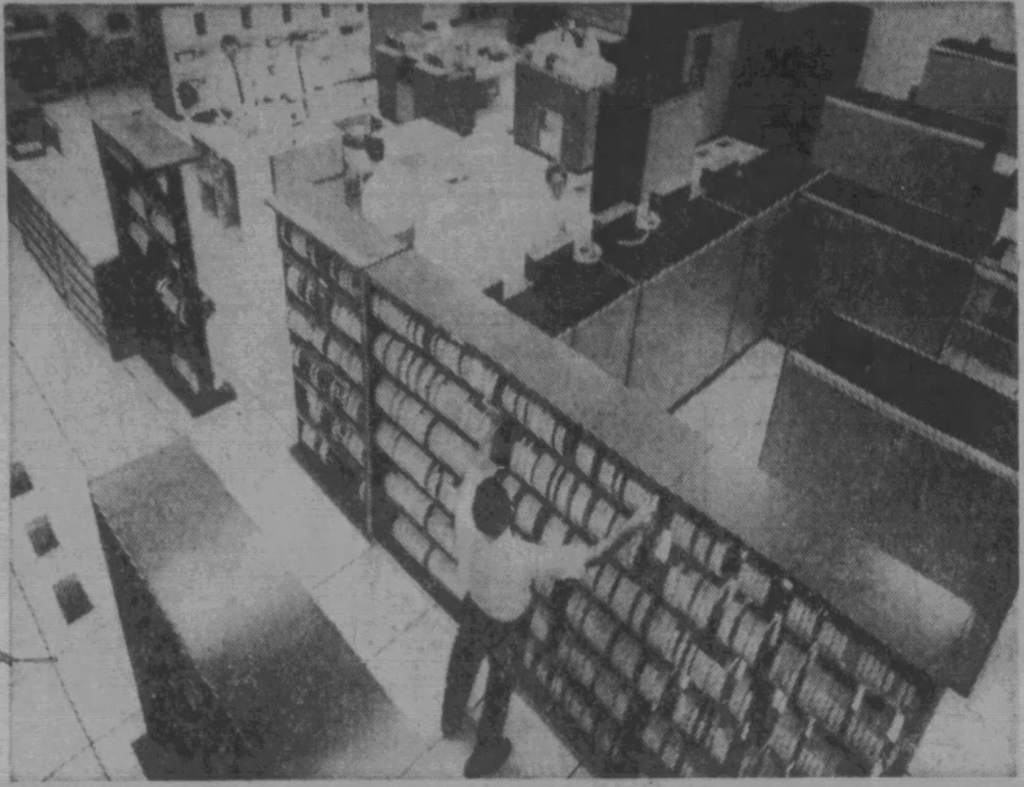
Photo from Hickory Daily Record Sept 16 1968. Caption:
Students, faculty and researchers at 38 North Carolina colleges and universities will be transmitting and receiving answers to thousands of problems daily this fall from this computer complex at Triangle Universities Computation Center. The large central computer (center rear), is linked directly to remote tele-processing terminals on each campus – from about 10 to 300 miles away – through telephone line connections.
This original system was an IBM System/360 Model 75. TUCC was partially funded by a $1.5M NSF grant. In 1968, UNC Chapel Hill had a IBM System 360/model 30 which “provided a limited amount of on-campus computer capability and served as a remote input/output terminal to the large-scale IBM System 360/model 75, available at TUCC”. (The Chapel Hill News, Sep 4 1968)
The Chapel Hill News reported Aug 22 1979 that TUCC has 32 employees “who provide information processing facilities and services, mostly via Duke, UNC and NC State”
in 1984, the universities tried to get a “supercomputer” from the National Science Foundation, but were not successful – only 5 grants were awarded for supercomputers, and the TUCC proposal was #6.
In 1987, a Chapel Hill applications programmer I job posting mentioned that TUCC had a 3081k
I came across this in late 1980s Internet research, there were references to “TUCC.TUCC.EDU”, and early hosts.txt file mentions:
HOST : 128.109.193.2 : TUCC.TUCC.EDU : IBM-3081 : MVS : TCP/TELNET,TCP/FTP,TCP/SMTP :
.. and that network 128.109.0.0 was assigned to “TUCC-MCNC” (MCNC was formed in 1980 and still exists today). a 1988 article mentions TUCC’s Internet connection:
Internet connects to the state’s northeastern Piedmont through the Triangle Universities Computation Center in RTP. From there, it connects with various North Carolina research campuses via the microelectronics center’s own microwave network.
(News and Record, Nov 6 1988)