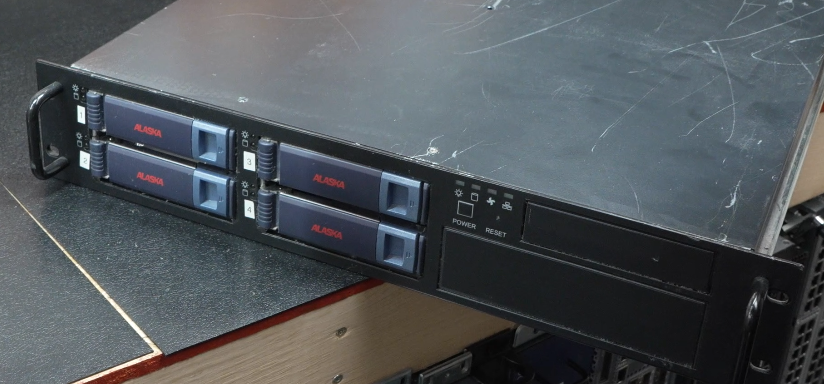
We recently pulled out this old 2U rackmount server. I set it up 10+ years ago as a personal file server, and recently realized the server wasn’t powering on. We determined the power supply had failed and then tried to figure out where this machine came from. With some help from our supporters, here’s what we’ve found:
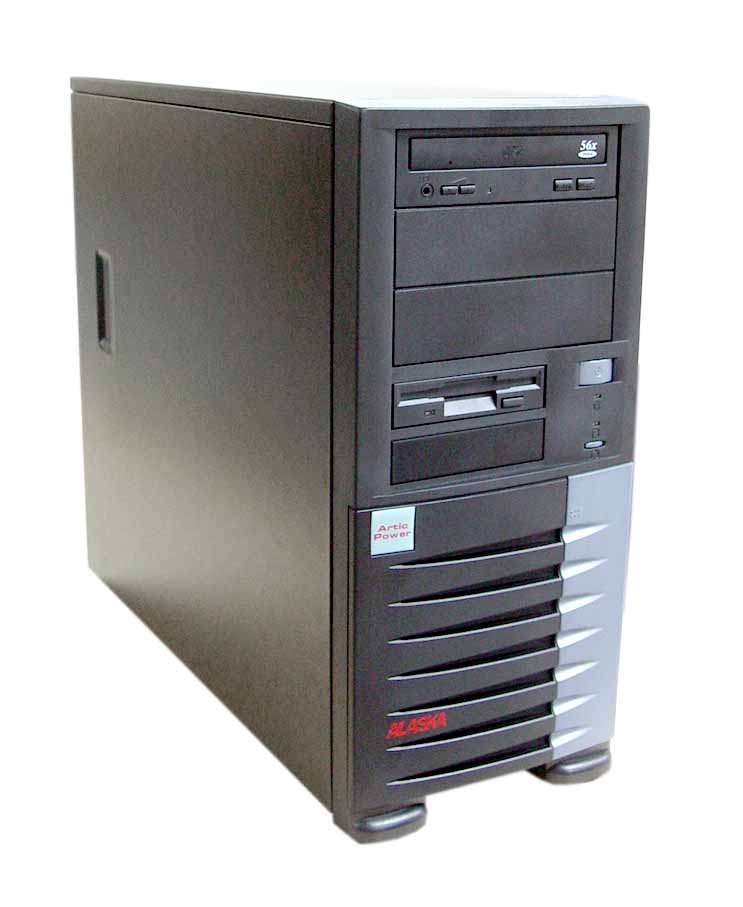
“Alaska” was a computer brand sold in Mexico in the late 1990s and early 2000s. Its server line was called “Alaska Artic Power.” The brand was created by Mexmal Mayorista S.A. de C.V. and Dinastía International Corp., both of which belonged to the same ownserhip group based in Laredo Texas and Monterrey.
The 2U rackmount unit we have is a Chenbro RM21200, a general purpose 2U chassis produced by Chenbro of Taiwan in the early 2000s. We found references to RM21200 compatibility with Intel motherboards such as the SCB2, perhaps it was targeted for Intel server builds?
The Alaska Brand

Dinastía and Mexmal launched the Alaska brand in 1998. The product names followed a cold weather theme: the servers were “Alaska Artic Power” and “Alpine”; desktops included “Icy Blue,” “Coastal,” “Equinox,” “Fortuna,” “Altura,” “Vidro,” and “Paxson”, and the notebooks were “Avalanche.”
Alaska computers were generally marketed as Intel based and Microsoft certified, and the company described itself as ISO 9001:2000 and Microsoft WHQL certified. In statements to the Mexican trade press in 2002 and 2003, the company described Alaska as a leading home PC brand in Mexico. A 2011 retrospective reported sales of about $160 million for 1998 and roughly 40 percent of the local white box market. Distribution extended across Mexico and into parts of Latin America, including Bolivia, Chile, Uruguay, Argentina, and Peru.
The Alaska Artic Power server line, recovered from the dinastia.com web store on the Internet Archive, ran from dual Pentium III models around 2000 to an AMD Athlon based model by 2003 (the Artic Power 3500/600).
The Company
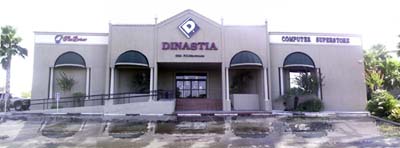
The group operated as three companies under common ownership: Dinastía International Corp. in Laredo, Texas, which handled purchasing and assembly; Mexmal Mayorista S.A. de C.V. in Monterrey, Nuevo León, the Mexican distribution arm; and a networking products arm, CNet. The founders were Patrick Wong and Alfredo Flores, and the business began around 1990. Dinastía’s reported sales grew from about $1 million in 1990 to about $81 million in 1996, and in 1997 the Laredo Morning Times named Wong and Flores Small Business Persons of the Year.
The collapse
The group ran into financial trouble in the early 2000s. On June 27, 2003 the International Finance Corporation (IFC), the private sector arm of the World Bank, lent Mexmal Mayorista $10 million. On March 10, 2005 the United States Dinastía entities filed Chapter 11 in the Southern District of Texas (In re Dinastia, L.P., No. 05-33650), and Mexmal Mayorista entered a concurso mercantil, a Mexican commercial bankruptcy, in Monterrey. The Mexmal concurso became a liquidation on August 30, 2006, and ASI Computer Technologies acquired the IFC debt and the assets.
Two United States federal court opinions document the aftermath: Enterasys Networks, Inc. v. Mexmal Mayorista (In re Dinastia, L.P.), 381 B.R. 512 (S.D. Tex. 2007), and Flores v. ASI Computer Technologies, Inc., Civil Action L-06-135 (S.D. Tex. 2010).
References
It was pretty hard to find materials about this company – so we’ve posted them online for reference
https://files.serialport.org/Alaska/